
490 Central Street
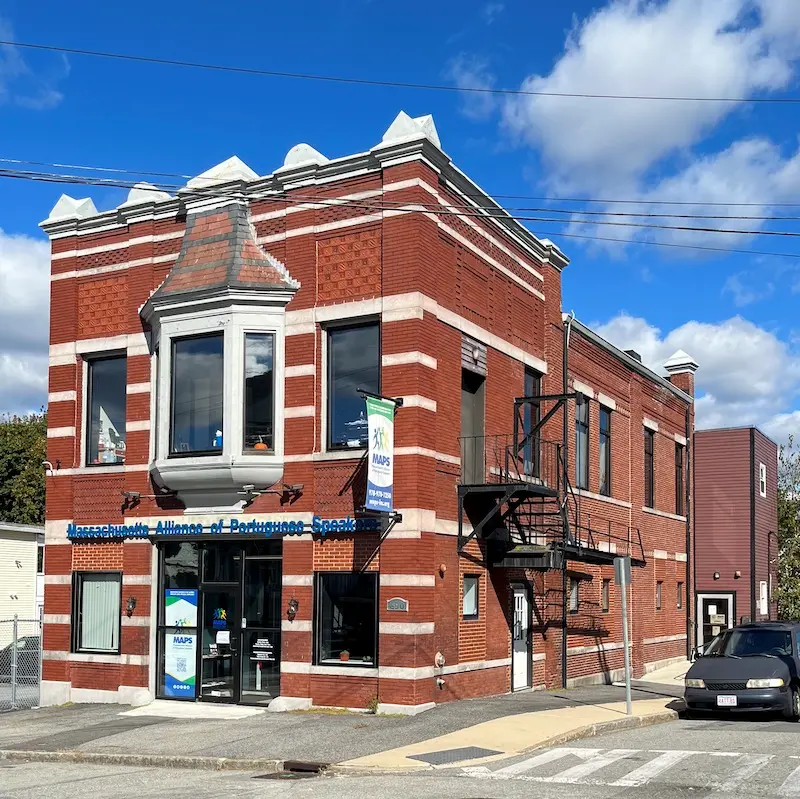
- Historic Name: Fire Station, Polish Club, Portuguese MAPS
- Uses: Fire station; club
- Date of Construction: 1886-7
- Style/Form: Victorian Polychrome
- Architect/Builder: Frederick Miller
- Foundation: Granite
- Wall/Trim: Brick
- Roof: Flat
- Major Alterations: Windows bricked up or replaced
- Condition: Good
- Included in Hengen survey? Yes
- Related oral interview? Yes
- Portuguese owned? Yes
- Recorded by: Gregory Gray Fitzsimons and Marie Frank
- Organization: UMass Lowell
- Date: July 2023
Description
This brick and masonry structure marks a significant change from the wooden firehouse built at 458 Central Street that it replaced, Hose Co. No. 6. It is two stories with an additional Doric attic on the front façade. The primary entrance for the engine faced Central Street. The floors are separated by stone stringcourses and there is an oriel window over the main entrance; the cap of the oriel extends up into the attic. The brickwork includes fish scales on the first story and terracotta squares and off-set bricks on the attic. The entrance and the oriel are both flanked by windows and six windows run the length of North Street on both stories. The North Street façade also has an exterior fire escape at the corner. By 1952 the building also included a small wooden extension off the back. The engine entrance has been converted to two standard size doorways. The windows are all new, single pane on the front façade and with a transom on the side façade. The windows on the north elevation, facing a parking lot, are all bricked up.
History
This building encapsulates both civic and community life in Back Central. In the 1870s, Andrew Wheelock owned the large corner lot at Central and North and the 1879 atlas indicates the presence of a few scattered structures. In 1886 however, Wheelock sold the property to the city in exchange for the property at 458 Central (see entry on that property). The impressive fire station cost around $10,000 and indicates the city’s investment in state-of-the-art fire protection. Although the construction date is 1886, its footprint is indicated on the 1882 atlas. The architect is listed as Frederick C. Miller. By 1920 however, the mayor suggested closing the station (along with two others) as a cost saving effort—both for maintenance and for manpower. The exact date of closure is not known, but by the early 1930s the Teamsters met in the building and in 1943 the city deeded them the property; in 1943 the Teamsters sold the property to the White Eagle Citizens Club, a social club of the Polish community. The 1952 atlas lists the property as a “club.” In April of 1965 the club reorganized as the Pulaski Political Club (named for Revolutionary War hero, General Casimir Pulaski) and it was managed by Polish-American Fred Bobola. In 2009, the club sold the building to Manuel Silva; in 2012 it was sold to the 490 Central Street Realty Trust; and in 2019 to 490 Central Street LLC. In 2021 the building was purchased by MAPS—the Massachusetts Alliance of Portuguese Speakers—and they renovated it to include private offices, a reception area, conference, and kitchen on the first floor and a large event space on the second. The Theodore Edson Parker Foundation contributed funds for a new wheelchair lift in the building.
Sources
- Sidney & Neff Map of Lowell, 1850.
- Lowell atlases 1879, 1882, 1906, 1924 & 1936.
- Lowell city directories.
- Elizabeth Hengen, Lowell Cultural Resources Inventory.
- Lowell Sun, Auction of Wheelock Estate, March 11, 1929
- Lowell Sun, Feb. 20, 1911, “Andrew C. Wheelock—One of Lowell’s Oldest Business Residents Is Dead.”
- Lowell Sun, Jan. 27, 1920 “Do Away With Fire Houses.”
- Article in Herald News: The Massachusetts Alliance of Portuguese Speakers (MAPS) will be opening its new office in the heart of Lowell’s Portuguese Speakers Hold Grand Opening New Lowell Office